
Investment gold · Technical guide
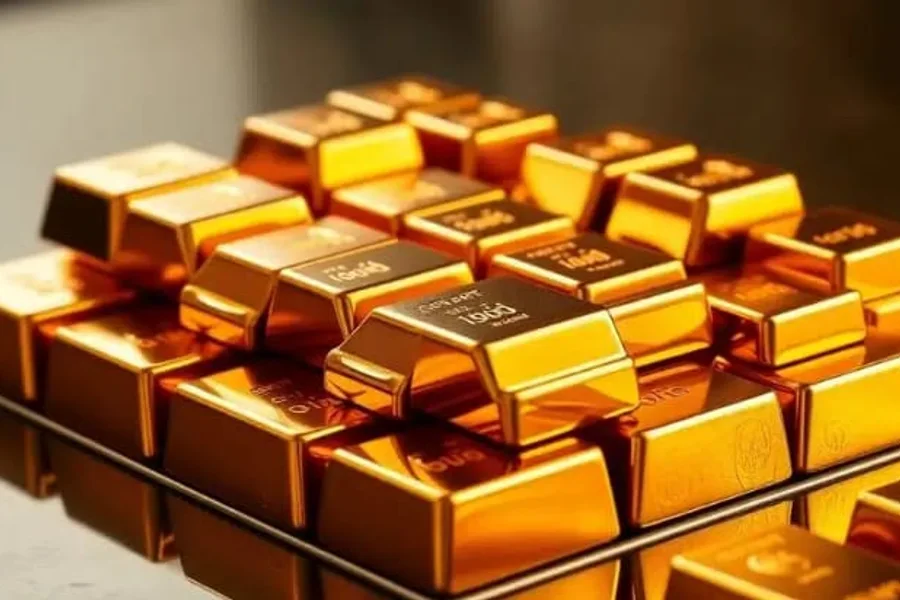
Gold bars
Everything that sets the value of a bar: weight, format, fineness, the refiner that issued it and the certificate that comes with it. Daniel Varela —gemmologist and appraiser since 1984— weighs and verifies it in front of you at Av. Alvear 1712.
This page is not a catalogue
We do not publish gold bar stock on the website. Here we explain how bars are classified, valued and verified. To have a bar appraised, to sell it or to ask about availability, message us on WhatsApp or book a private appointment.
Starting point
What a bar is — and what it isn't
A gold bar is investment gold: a piece whose value does not depend on design or signature, but on the fine metal it contains. Unlike a jewel, where craftsmanship, brand and condition all weigh in, a bar comes down to a short equation —weight × fineness × spot price— and everything else is verification.
That does not make it a simple object. Two bars of the same weight can be worth different amounts depending on how they were manufactured, which refiner issued them and whether they still hold their blister pack and certificate. The difference is not in the gold: it is in how much trust they carry, and therefore in how fast and at what price they turn into money.
The four variables we look at on the table are always the same: weight, format (minted or cast), fineness and traceability. Below, one by one.
Types by weight
From 1 gram to 1 kilo
Bars are produced in a standardised range of weights. The rule worth understanding before buying or selling: the smaller the bar, the higher the percentage premium —what you pay above the gold content, to cover manufacturing, packaging and certificate—. The kilo bar is the most efficient format per gram; the single gram is the least efficient, but it is the only entry point for many buyers.
| Format | Fine gold | Who it suits |
|---|---|---|
| 1 g | 1 g | First purchase, gift or symbolic saving. The format with the highest percentage premium: you pay a lot of manufacturing for very little gold. |
| 2.5 g | 2.5 g | Gift and drip saving. Still an expensive bracket per gram, but it lets you start without a large outlay. |
| 5 g | 5 g | Staged saving, monthly purchases. The premium starts to come down, though it is still high. |
| 10 g | 10 g | The first bracket that genuinely works as a store of value. A good balance between accessibility and premium. |
| 20 g | 20 g | Middle bracket, common in the European market. Sells whole without difficulty. |
| 1 troy ounce | 31.1035 g | The reference unit of the international gold market. Maximum comparability and liquidity: quoted and compared in any market in the world. |
| 50 g | 50 g | Investors who want mid-sized tickets while keeping some ability to sell in parts. |
| 100 g | 100 g | The most common investment format among private holders. Very good premium-to-value ratio, and it sells whole with ease. |
| 250 g | 250 g | A consolidated position. The premium per gram drops, but flexibility is lost: partial selling is no longer an option. |
| 500 g | 500 g | Wealth holding. Stored and sold whole; the ticket is large and the pool of buyers smaller. |
| 1 kg | 1,000 g | The most efficient format per gram: the lowest percentage premium on the scale. In exchange, it requires a large outlay and can only be sold whole. |
1 g · 1 g
First purchase, gift or symbolic saving. The format with the highest percentage premium: you pay a lot of manufacturing for very little gold.
2.5 g · 2.5 g
Gift and drip saving. Still an expensive bracket per gram, but it lets you start without a large outlay.
5 g · 5 g
Staged saving, monthly purchases. The premium starts to come down, though it is still high.
10 g · 10 g
The first bracket that genuinely works as a store of value. A good balance between accessibility and premium.
20 g · 20 g
Middle bracket, common in the European market. Sells whole without difficulty.
1 troy ounce · 31.1035 g
The reference unit of the international gold market. Maximum comparability and liquidity: quoted and compared in any market in the world.
50 g · 50 g
Investors who want mid-sized tickets while keeping some ability to sell in parts.
100 g · 100 g
The most common investment format among private holders. Very good premium-to-value ratio, and it sells whole with ease.
250 g · 250 g
A consolidated position. The premium per gram drops, but flexibility is lost: partial selling is no longer an option.
500 g · 500 g
Wealth holding. Stored and sold whole; the ticket is large and the pool of buyers smaller.
1 kg · 1,000 g
The most efficient format per gram: the lowest percentage premium on the scale. In exchange, it requires a large outlay and can only be sold whole.
The troy ounce —31.1035 g— is not the common ounce of 28.35 g. The entire international gold board is quoted in troy ounces: when you read “USD per ounce”, this is the one.
Types by manufacture
Minted vs. cast
Two ways of making the same thing. The difference is paid for —and verified— differently.
Minted
Cut and pressed
Cut from a rolled sheet and struck with dies. The result is a bar with straight edges, a mirror surface and crisp engraving. It leaves the refinery sealed in a blister pack —PAMP's CertiCard is the best-known case— with the serial number in plain sight and the assay certificate built into the card.
- Sealed blister pack with a visible serial number
- Assay certificate integrated into the card
- Mirror finish, sharp edges and crisp engraving
- Higher premium per gram: you pay for the manufacturing
- Verified without opening it: weight, dimensions and seal

Cast
Poured into a mould
Molten gold is poured into a mould and left to solidify. The result is a rougher-looking bar, with an irregular surface and rounded edges. Markings are applied afterwards. It is the classic format for large brackets —500 g, 1 kg— and for wholesale bars.
- Cheaper per gram: less manufacturing process
- Usually comes with a loose certificate, not a blister pack
- Irregular surface: no two bars are ever identical
- Different verification: the assay matters more than the seal
- Dominant in large formats and in the wholesale market
Neither is better. The minted bar buys liquidity and ease of resale; the cast bar buys gold. If the goal is to accumulate metal, a large cast bar yields more per unit of weight. If the goal is to be able to sell quickly and without discussion, a sealed minted bar liquidates more easily.
Purity
What .9999 actually means
The fineness of a bar is the proportion of fine gold over total weight, expressed in thousandths. The standard for modern investment gold is .9999 —24 karat—: what the market calls “four nines”, 99.99 % pure gold. The remaining 0.01 % is residual trace from the refining process, not a deliberate alloy.
.9999
Four nines · 999.9
99.99 % pure gold. The standard for contemporary investment bars and coins. Equivalent to 24 karat.
.999
Three nines · 999.0
99.9 % pure gold. The classic standard, still current on older bars and coins. Also considered 24 karat.
.995
Wholesale minimum · 995.0
99.5 % pure gold. This is the minimum fineness the LBMA requires of a Good Delivery bar. It is not a lower-quality bar: it is a different standard, designed for the wholesale market.
A difference in fineness changes the fine gold content, and therefore the value. A .9999 kilo bar holds 999.9 g of gold; a .995 kilo bar holds 995 g. The maths is done on the gold, not on the gross weight.
Refiners
Why the mark stamped on the bar matters
The refiner is whoever melted, assayed and certified that gold. Its stamp is, in practice, the signature backing the declared fineness. A bar from an accredited refiner is bought and sold anywhere with minimal verification. A bar with no recognised mark is not worth less gold —it is worth the same per gram of fine metal— but it demands a longer assay, finds fewer buyers and tends to be penalised on the spread. That is what liquidity means: the difference between selling today and selling when someone turns up.
UBS
Switzerland. The most requested brand in the local market. The bank owned the Argor refinery —that partnership gave rise to Argor-Heraeus— and its bars usually carry the Kinegram, the security hologram they developed together, which is very hard to counterfeit. In 2023 UBS absorbed Credit Suisse.
PAMP Suisse
Switzerland. The most recognised name in global retail; its bars come in a CertiCard blister pack with a serial number.
Valcambi
Switzerland. Refinery in Balerna; also known for the CombiBar format, divisible into small tabs.
Argor-Heraeus
Switzerland. Refinery in Chiasso, with a strong presence in the European market.
Metalor
Switzerland. A historic refiner, with over a century of operations in precious metals.
Heraeus
Germany. The Hanau group, one of the major European refiners.
Perth Mint
Australia. A mint owned by the Government of Western Australia; bars and coins with state backing.
Credit Suisse
Switzerland. A historic bar brand. The bank no longer exists as an independent entity, but its bars still circulate and are accepted normally.
Wholesale standard
LBMA Good Delivery
The London Bullion Market Association sets the Good Delivery standard: the specification a bar must meet to be accepted without question in the London wholesale market. This is the gold moved by central banks, bullion banks and large funds.
It is not what a private holder buys. A Good Delivery bar weighs around 400 troy ounces —roughly 12.4 kilos— and today represents a sum no ordinary saver moves in a single transaction. We mention it because the term appears constantly in gold marketing, and it is worth knowing exactly what it refers to.
- Nominal weight
- ≈ 400 troy oz (≈ 12.4 kg)
- Accepted range
- 350 – 430 troy oz of fine gold
- Minimum fineness
- 995.0 thousandths (.995)
- Issuer
- Refiner accredited on the Good Delivery List
- Who uses it
- Central banks and the wholesale market
If someone offers you a “100-gram Good Delivery bar”, there is a vocabulary problem. Private holders operate on the 1 g to 1 kg scale; Good Delivery is another league.
Traceability
Certificate, serial number and blister pack
The serial number is what ties that specific bar to its assay certificate. It is engraved on the metal and repeated on the refiner's card or paperwork: if the two do not match, the transaction stops there.
And a warning we always give: do not break the blister pack. A sealed minted bar sells for what its certificate says; the same bar out of its pack has to be reassayed and loses part of its liquidity. The plastic is not packaging: it is part of the value.
Valuation
How the figure is calculated
Value = weight (g) × fineness (e.g. 0.9999) × spot price (USD/g) − spread
The price of a bar is not negotiated the way a jewel's is: it is calculated. The fine gold content is multiplied by the day's international spot price, and from that the spread is deducted —the margin covering verification, refining and market risk until the metal is placed—.
The board we publish is a technical reference, not an offer. The firm figure comes from the table: Daniel weighs the piece on a precision scale, verifies it and walks you through every step of the calculation in front of you.
- 01
Weighed in front of you
Precision scale on the table. You see the number as it comes up, not one we report to you afterwards.
- 02
Verification
Serial number against certificate, standardised dimensions and non-destructive assay. The piece is never marked or scratched.
- 03
Calculation and firm offer
The day's spot price is applied to the fine gold content and the spread is explained to you. If you accept, payment is made on the spot.
Authenticity
How a bar is verified
A fake bar is rarely a painted brass block: that is ruled out in seconds. The real problem is far more sophisticated, which is why verification never rests on a single test but on several that cross-check each other.
Exact weight and dimensions
Every format has measurements standardised by the refiner. A deviation of tenths of a gram, or of millimetres in thickness, is the first alarm: a forger who gets the weight right usually misses the geometry, and vice versa.
Serial number
Checked against the certificate and, with several refiners, against their register. Retouched engraving, uneven depth or the wrong typeface stops the transaction.
Gold is not magnetic
A strong magnet should produce no reaction at all. The test is quick and useful, but limited: it rules out ferrous fillers, not tungsten.
Ultrasound and conductivity
These measure what happens inside the metal, not on its surface. The speed of sound and the electrical conductivity of gold differ from those of any possible filler, and that is where what a surface analysis cannot see finally shows up.
The tungsten warning
Tungsten has a density practically identical to gold's (≈ 19.3 g/cm³ for both). That means a tungsten core plated in gold can have the right weight and the right size, and pass a density test. An XRF analysis is not enough on its own either: it reads only the surface layer and sees gold, because gold is what is there. That is why, on bars of meaningful weight, verification is done by ultrasound or conductivity —methods that pass through the piece without damaging it—.
Frequently asked
What people ask us about gold bars
How much is a 100-gram gold bar worth?
It is worth its fine gold content at the day's spot price, minus the spread. A 100 g bar of .9999 fineness contains 99.99 g of pure gold: you multiply that quantity by the international price per gram and deduct the margin. We do not publish a fixed price because gold moves every day —the updated reference is on our spot price board—.
Is a bar better than a gold coin?
It depends on the purpose. A large bar yields more per gram: the greater the weight, the lower the percentage premium. Investment coins usually carry a slightly higher premium, but they are widely recognised, easier to break up and sometimes add numismatic value. To accumulate metal, the large bar. To keep liquidity in small increments, the coin.
Do you buy bars without a certificate?
Yes. Gold is worth the same per gram of fine metal with or without paperwork. What changes is the procedure: without a certificate we run a full purity verification on the spot, and that takes longer at the table. The certificate adds no gold; it adds speed and confidence.
Do you pay on the spot?
Yes. If you accept the figure the calculation produces, payment is made immediately —cash or transfer— with a formal receipt. There is no forced consignment and no waiting periods: you decide at the table and leave with either the money or the piece.
What documentation do you ask for?
Photo ID, to issue the receipt for the transaction. If you have the bar's certificate, the purchase invoice or any refiner paperwork, bring it: it speeds up verification. If you don't have it, we still do business.
Do you have bars for sale?
We do not publish gold bar stock on the website, and this page is not a catalogue. Availability is checked directly on WhatsApp or at a private appointment at Av. Alvear 1712.
Do I have to break the blister pack for you to appraise it?
No, and we ask you not to. A sealed minted bar is verified without opening it: weight, dimensions, serial number and non-destructive assay. Breaking the pack forces a reassay and permanently reduces the bar's liquidity.
What does “four nines” or .9999 mean?
That the piece is 99.99 % pure gold —999.9 parts of gold per 1,000—. It is the purity standard of modern investment gold and is equivalent to 24 karat. The rest is residual trace from refining, not an alloy.
What is a Good Delivery bar?
It is the LBMA's wholesale standard: bars of around 400 troy ounces —roughly 12.4 kg— with a minimum fineness of .995, issued by accredited refiners. They are moved by central banks and the London market. It is not the format a private holder trades in.
How do I know my bar has no tungsten inside?
Because it is verified with methods that pass through the metal. Tungsten has almost the same density as gold, so weighing the piece or measuring its density is not enough, and an XRF only reads the surface. Ultrasound and electrical conductivity do detect the core, and they do not damage the bar.
Bring the bar and we'll look at it together
We weigh it, verify it and explain the calculation in front of you, in a private appointment at Av. Alvear 1712. The appraisal commits you to nothing: if the number doesn't work for you, you take the piece home.
Av. Alvear 1712 · entre Rodríguez Peña y Av. Callao · Lunes a viernes de 10 a 18 h · atención por entrevista privada